
Tether (USDT) To Face Do or Die Situation in 2021: Messari Report

Tether is the cryptocurrency industry’s biggest threat in 2021, says a report penned by Messari’s Founder Ryan Selkins.

The 134-page thesis ventured into the stablecoin’s emergence as a proxy for the US dollar that helps crypto traders getting in and out of their positions quickly on exchanges. It also focused on the controversy that tails Tether following the New York State Attorney’s class-action lawsuit against its founders and a sister cryptocurrency exchange BitFinex.

Boom Against Gloom

Lawyers Vel Freedman and Kyle Roche alleged in their October 2019 filing that Tether defrauded its investors, manipulated the cryptocurrency markets, and concealed illicit proceeds. They added that Tether printed billions of dollars’ worth of USDT stablecoin to artificially inflate the price of Bitcoin, Ethereum, and other cryptocurrencies.

But the market largely ignored the warnings. Tether’s market capitalization soared from $4 billion in October 2019 to $20.9 billion in December 2020. Mr. Selkins noted that the exchanges largely boosted Tether’s popularity in the absence of any other voluminous alternative. However, the situation could change in 2020.
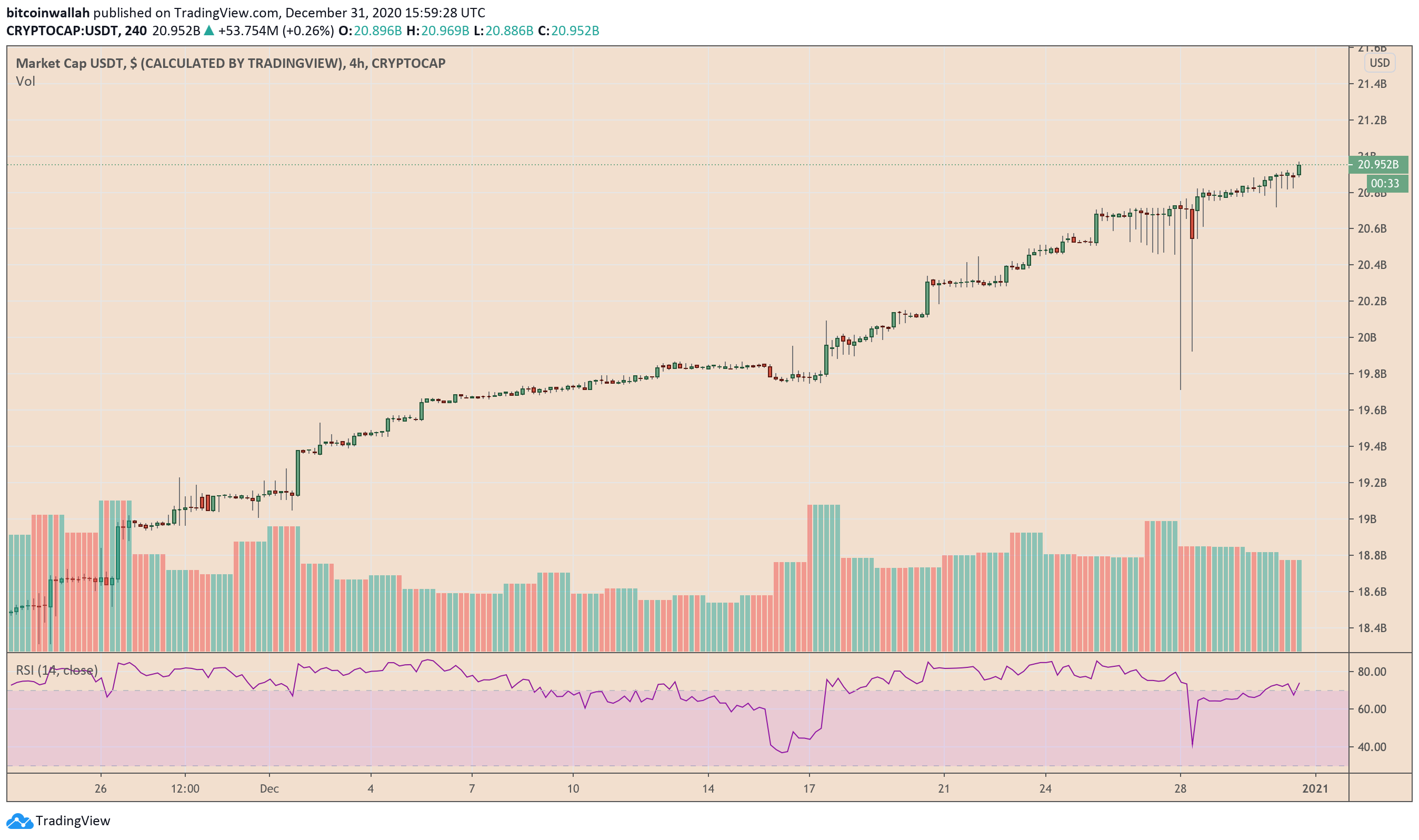
Bitcoin, cryptocurrency, BTCUSD, BTCUSDT, Tether, USDT
Tether market cap. Source: USDT on TradingView.com

The research analyst discussed the worst-case scenario for Tether and BitFinex, citing the “dual lawsuits” against BitMEX filed by the Commodity Futures Trading Commission and Departmnent of Justince. He stated that an active investigation against the crypto derivative exchange caused its users to migrate towards alternative platforms.

Fearing the same could happen to Tether, Mr. Selkins presented a polar opposite Tether outlook for 2021 — a do or die situation as its market cap continues to grow amid an ongoing cryptocurrency market rally led by Bitcoin.

“Tether will either have an existential crisis or double its supply again in 2021,” he wrote. “There doesn’t seem to be a middle ground.”

SEC Investigation Rumor

Following the Securities and Exchange’s lawsuit against Ripple and its grossly negative impact on the firm’s native token, XRP, many agree that the Tether’s USDT could suffer a similar fate. But for that, the US Treasury needs to categorize stablecoins as securities.

And that is looking to come true. A Twitter user @RealWillyBot shared details about a DoJ order that ruled stablecoins as securities. He shared a screenshot that read:

“Depending on its design and other factors, the stablecoin may constitute a security, commodity, or a derivative subject to the US federal securities, commodity, or/and derivatives laws.”

If the proposal becomes a law, then USDT will become a security token. That could shock the cryptocurrency markets on the whole due to its overly addiction to the stablecoin that coughs out an average of $77 billion worth of transactional volume every day.


from NewsBTC https://ift.tt/2KTNfbH
via IFTTT

Comments

Popular posts from this blog

ENS DAO delegates offer perspective on DAO governance and decentralized identity

AlphaWallet CEO and Spruce co-founder talk about their roles as contributors to the Ethereum Name Service following the project's recent airdrop. Earlier this month, the Ethereum Name Service, or ENS, formed a decentralized autonomous organization, or DAO, for the ENS community.  Cointelegraph spoke to two ENS DAO delegates who applied for the opportunity to represent the community and stay involved in the decision making process: Victor Zhang, CEO of AlphaWallet, an open source Ethereum wallet, and Gregory Rocco, co-founder of Spruce, a decentralized ID and data toolkit for developers. Zhang spoke about his experience as an external contributor to ENS and an early supporter since 2018. Zhang initially sought to help ENS by offering Alpha Wallet as a user-friendly tool for  resolving .eth names and cryptocurrency wallet addresses. Essentially, if a user inputs an .eth name in the AlphaWallet, it will show the wallet address, and vice versa using reverse resolution. Alpha...

How Social Platform Chingari is Using Web 3.0 to Transform the Traditional Way We Use Social Media

The world is changing. This isn’t news to anyone, but sometimes it is nice to realize that—contrary to news headlines—not all the change is bad.  In fact, the last decade has seen so much innovation and so many improvements to technology that even 2015 seems like a different world.  Internet speeds, connecting with anyone globally (for free), and our ability to reach large groups of people without a middleman is nothing short of revolutionary. When it comes to technology evolution, this often happens with different iterations.  Once a system is mature, there’s a better idea of what we would like to change and improve.  We go back to the drawing board, target our creative minds at the issues, and create a new version that has evolved to better meet our needs.  The Internet has followed this model since its inception, evolving through three distinct stages.  We are only at the cusp of the third stage, called Web 3.0, with technologies such as blockchain and ...

Lightning Network Exploits Continue to Hinder the Bitcoin Scaling Solution

via Bitcoin News https://ift.tt/3mGmODQ While bitcoin has run-up to all new price highs in 2020, a great number of crypto supporters have been complaining about the mempool backlog and the high fees needed to send a transaction. Meanwhile, the Lightning Network is far from seeing widespread adoption, and a number of attack vectors have been revealed this year. At the time of publication, the Bitcoin ( BTC ) mempool (backlog of transactions) shows 113,000+ unconfirmed transactions and the backlog hasn’t been this high since 2017. When the bull run took place three years ago, transaction fees and unconfirmed transactions shot through the roof. Currently, according to bitcoinfees.cash data on October 31, the next BTC block fee is $10.77 and the current median fee is $6.43. Even with the high fees and the mempool clog , the greater bitcoin community is still transacting mostly onchain. The Layer 2 protocol built on top of Bitcoin called the Lightning Network (LN) was supposed to eas...